

The enterprise resource planning (ERP) landscape is evolving rapidly, with technological advancements leading the charge.
Recent trends show a significant shift towards cloud-based solutions, driving enhanced scalability and flexibility for businesses.
While traditional on-premise ERP systems still hold their ground, the increasing demand for digital agility is pushing enterprises to explore cloud alternatives.
One of the key innovations making waves right now is the integration of artificial intelligence (AI) and machine learning within ERP systems.
These technologies enable predictive analytics, streamlining operations to provide valuable insights for decision-makers.
Additionally, there's a growing emphasis on personalized user experiences, with ERP vendors focusing on enhancing the user interface and experience through modern design principles.
Despite technological advancements, there are challenges that companies must navigate.
The transition to cloud ERP requires robust data security measures as data breaches remain a critical concern.
Moreover, inconsistencies between ERP modules and legacy systems can lead to integration hurdles, necessitating a strategic approach to implementation.
A notable case study exemplifying successful ERP adaptation is Tesla's deployment of a custom-built ERP system that integrates seamlessly with their unique operational needs.
Their approach highlights the importance of tailor-made solutions, aligning technology with business strategy.
As the ERP ecosystem continues to grow, staying informed on the latest trends and innovations is crucial for companies to harness the full potential of these systems.
Estimated reading time: 1 minute, 11 seconds
Adapting to the Shifting ERP Landscape: Recent Innovations and Challenges Featured
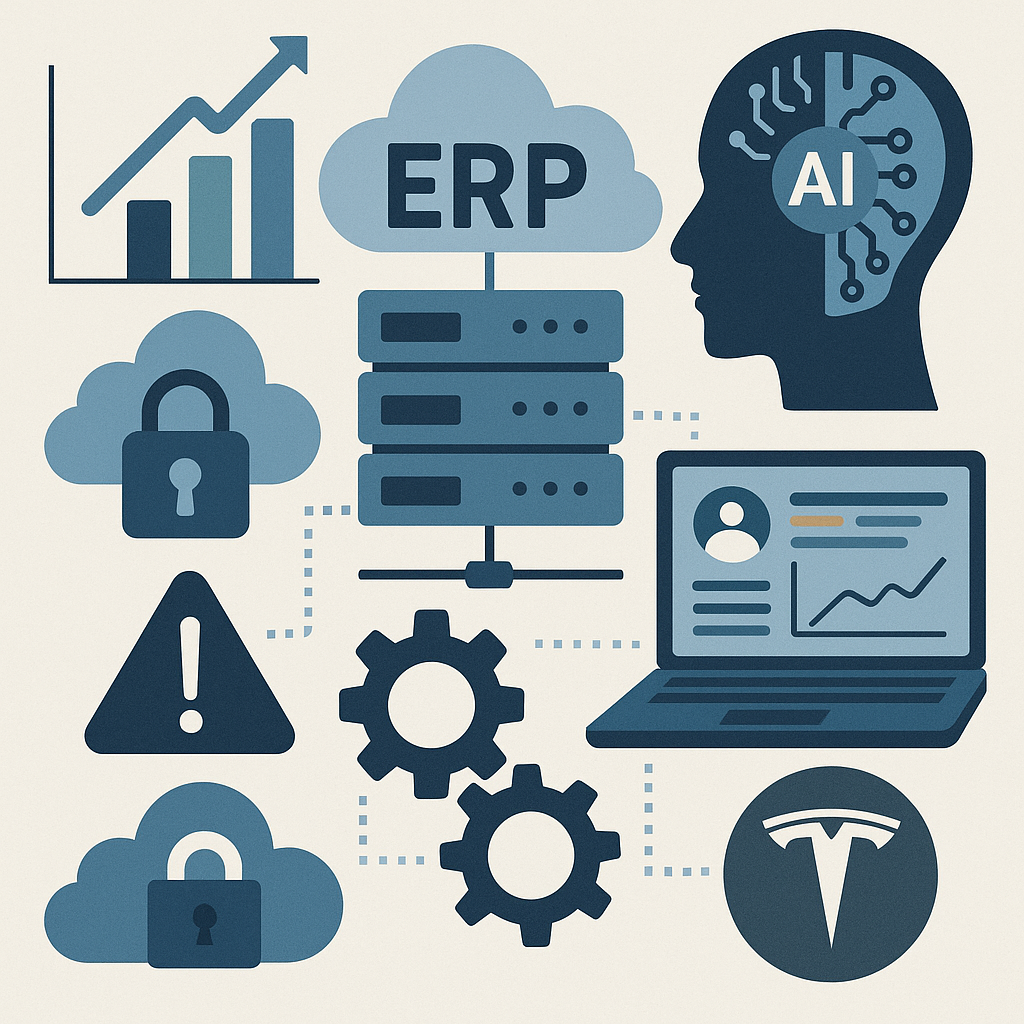 Explore the rapid advancements in ERP technology, focusing on cloud-based solutions and challenges posed by AI integration.
Latest from ERP Global Insights
- The Rise of Cloud-Based ERP Systems: A Game Changer in Business Management
- Revolutionizing ERP Systems: The Newest Product Innovations
- The Rise in Automated Financial Reporting: A New Business Norm
- Emerging Trends in ERP: Fostering Efficiency and Innovation
- Unveiling the Latest ERP Innovations: A Leap Towards Automation
Most Read
-

-
May 19 2021
-
Written by BobWScott
 Just what kind of year has it been for the…
-
-

-
May 22 2017
-
Written by mark
The last year has been one of change—the cloud has…
-
-
-
May 22 2017
-
Written by BobWScott
The last year has been one of change—the cloud has…
-
-
-
May 25 2016
-
Written by mark
Annual Report: 2016 BSI Top 100 VARs The web has…
-